Why These Three Hormones, Together
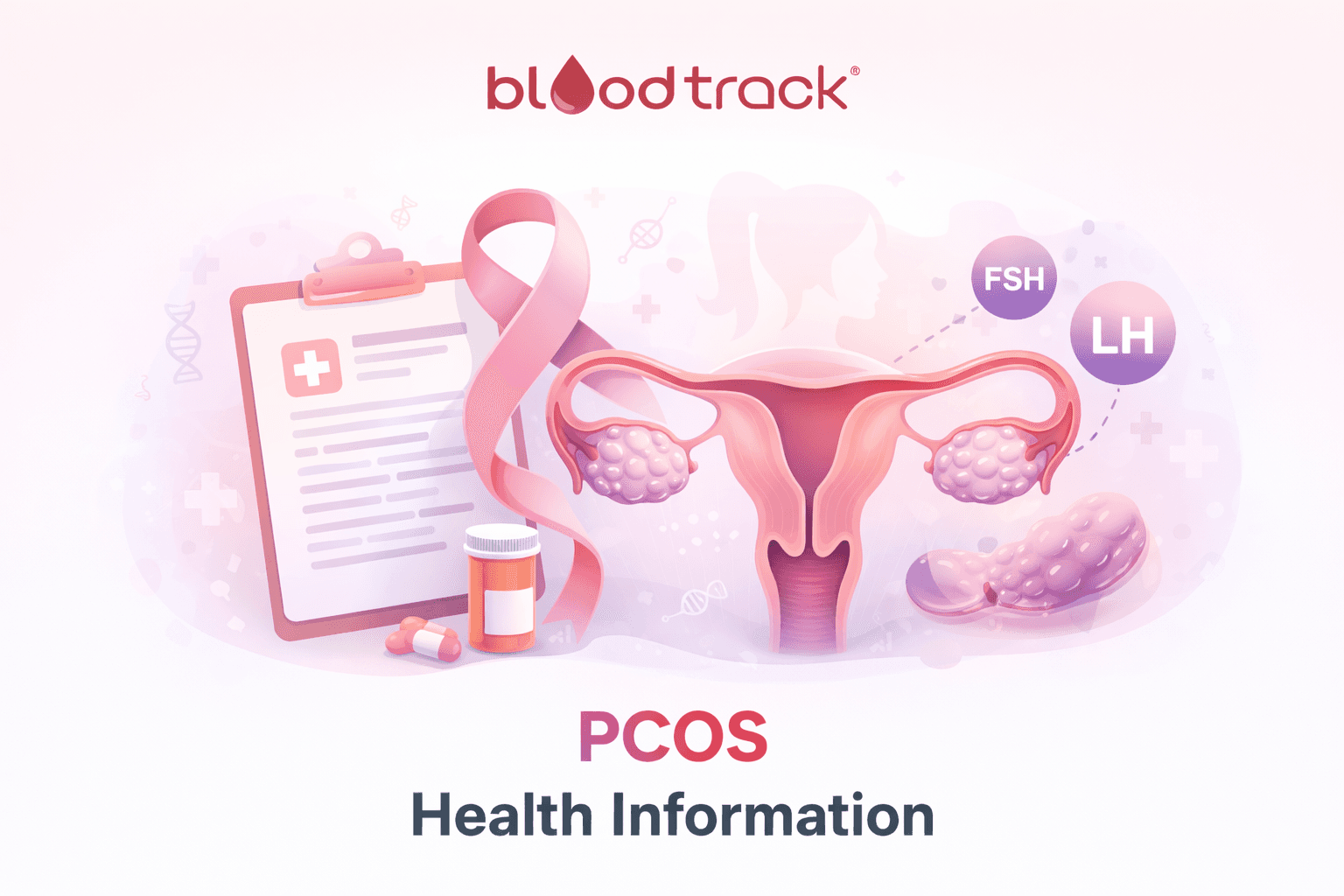
FSH (follicle-stimulating hormone), LH (luteinising hormone) and AMH (anti-Müllerian hormone) form the core fertility blood-test panel for Australian women. They answer three different but related questions:
- AMH — How many eggs do you have left? (ovarian reserve)
- FSH — How hard is your brain working to recruit an egg this month? (high FSH = ovaries struggling)
- LH — Are you ovulating? Or is the LH:FSH balance disrupted (as in PCOS)?
Together they support diagnosis of polycystic ovary syndrome (PCOS), planning for assisted reproductive technology (ART/IVF), confirming menopause when the picture is unclear, and investigating irregular periods or unexplained subfertility. Each hormone has its own quirks around when to test and how to interpret the result.
Australian Reference Ranges
| Test | Range | Notes |
|---|---|---|
| AMH (premenopausal) | Age-dependent: 25y ~25–35; 30y ~15–25; 35y ~8–15; 40y ~3–8 pmol/L | Same on any cycle day. Below 5 pmol/L at any age = reduced ovarian reserve |
| AMH (postmenopausal) | <1 pmol/L | Confirms exhausted ovarian reserve |
| FSH (follicular phase, day 2–4) | 3–10 IU/L | Best window for ovarian-reserve assessment |
| FSH (mid-cycle peak) | 4–25 IU/L | Brief surge co-occurring with LH peak |
| FSH (luteal phase) | 1–8 IU/L | Lower than follicular |
| FSH (postmenopausal) | >30 IU/L on two samples 4–6 weeks apart | Confirms menopause |
| LH (follicular) | 2–10 IU/L | Day 2–4 baseline |
| LH (mid-cycle ovulation surge) | 14–96 IU/L | Triggers ovulation 24–36 hours later. Lasts 24–48 hours |
| LH (luteal) | 1–11 IU/L | Lower than follicular |
| LH:FSH ratio (early follicular) | ~1:1 normal; >2:1 supports PCOS | Useful when other PCOS criteria are borderline |
| FSH (men) | 1.5–12 IU/L | Monitors testicular function in male infertility workup |
| LH (men) | 1.5–9 IU/L | Tested with FSH and testosterone for male hypogonadism |
Reference ranges vary slightly between Australian labs (Sullivan Nicolaides, Dorevitch, Laverty, Australian Clinical Labs all use the same RCPA-aligned standards but report a small variation depending on assay platform — particularly for AMH, where different methods can disagree by 10–15%). Always read the range printed on your own pathology report.
AMH — The Best Single Marker of Ovarian Reserve
AMH is produced by the granulosa cells around small developing follicles in the ovary. The bigger the pool of follicles waiting to mature, the higher your AMH — so AMH directly measures the size of your remaining ovarian reserve. Crucially:
- It does not vary across the menstrual cycle. You can test on any day, including while on the contraceptive pill (though the pill suppresses AMH by 20–30%, so values run lower).
- It declines steadily with age. AMH falls roughly 5–10% per year from your mid-20s onwards, accelerating after 35.
- It is the strongest predictor of how many eggs an IVF cycle will retrieve. An AMH of 25 pmol/L typically yields 12–18 eggs; an AMH of 5 pmol/L typically yields 2–5.
- It does not directly predict natural conception chances. A low AMH at 32 does not mean it will be hard to conceive naturally — it means the egg supply is lower than typical for that age and there is less time to defer.
What lowers AMH
Age (the dominant factor), smoking (reduces AMH by ~15–20%), chemotherapy and radiotherapy, ovarian surgery (especially endometrioma removal), genetic conditions (Fragile X premutation, Turner syndrome), and the contraceptive pill while on it (reverses within 3–6 months of stopping).
What raises AMH
Polycystic ovary syndrome — PCOS women often have AMH 2–3× higher than age-matched controls because of the multiple small follicles characteristic of the condition. AMH above 35 pmol/L in an adult woman strongly supports PCOS as part of the workup.
FSH and LH — When and How to Test
FSH and LH are pulsatile hormones secreted by the pituitary gland that drive the menstrual cycle. Their interpretation depends entirely on when in the cycle they are measured.
Day 2–4 (early follicular)
The standard assessment window. The bloods are timed for cycle days 2, 3 or 4 (counting day 1 as the first day of full menstrual flow). At this point:
- FSH should be 3–10 IU/L. Above 10 suggests reduced ovarian reserve; above 15 strongly suggests it.
- LH should be 2–10 IU/L.
- The LH:FSH ratio is most diagnostic for PCOS — a ratio above 2:1 supports the diagnosis when combined with other Rotterdam criteria.
- Oestradiol is often added — if oestradiol is high (above 200 pmol/L) on day 2–4, it suggests the cycle has started early and the FSH may be artificially suppressed.
Mid-cycle (day 13–14 in a 28-day cycle)
The LH surge — a brief but dramatic rise (14–96 IU/L) that triggers ovulation 24–36 hours later. Useful for confirming ovulation, but most patients simply use home urine ovulation predictor kits which detect the same surge cheaply and conveniently.
Luteal phase (day 21 in a 28-day cycle)
FSH and LH return to low baseline. This is the standard window for measuring progesterone to confirm ovulation occurred (progesterone above 30 nmol/L confirms a healthy ovulation).
The Three Most Common Patterns You Will See
Pattern 1: PCOS
Day 2–4 panel: LH:FSH ratio above 2:1, AMH typically 35–60 pmol/L (high), normal or borderline FSH, free testosterone often raised, SHBG often low. Combined with the Rotterdam criteria (irregular periods, polycystic ovaries on ultrasound, clinical or biochemical hyperandrogenism), this confirms PCOS.
Pattern 2: Reduced ovarian reserve
Day 2–4 FSH above 10 IU/L (often 12–25), AMH below 5 pmol/L (often well below for the patient''s age), normal LH. Sometimes the pattern emerges in the early 30s in women with previous chemotherapy, surgery, smoking history, or family history of early menopause. Not the same as menopause — these women still cycle and can still conceive, but ART success rates and natural conception rates are reduced.
Pattern 3: Menopause / premature ovarian insufficiency
FSH consistently above 30 IU/L on two samples 4–6 weeks apart, LH usually above 20 IU/L, AMH below 1 pmol/L, oestradiol below 100 pmol/L. In women over 45 with appropriate symptoms (irregular periods then amenorrhoea, hot flushes), the Australasian Menopause Society confirms diagnosis is clinical and bloods are usually unnecessary. In women under 45, this hormone pattern confirms premature ovarian insufficiency and triggers genetic, autoimmune and chromosomal workup.
What Affects Accuracy
- Hormonal contraception — the pill, IUD with hormones, depot injections, and implants all suppress FSH, LH and (modestly) AMH. Stop hormonal contraception for at least 1–3 months before testing if accurate baseline values are needed.
- Pregnancy and recent pregnancy — both FSH and LH are suppressed for several months postpartum.
- Significant weight loss or weight gain within the past 3 months — both can disrupt the hypothalamic-pituitary axis and alter all three hormones.
- Stress, intense exercise, low body fat — can produce hypothalamic amenorrhoea with low FSH and LH (instead of the high FSH seen in true ovarian failure). The pattern matters for diagnosis.
- Time of day — less critical than for testosterone, but morning samples are still preferred for consistency.
Medicare and Cost in Australia
FSH and LH are covered under the standard MBS schedule for any clinical indication (irregular periods, suspected menopause, PCOS workup, infertility) and bulk-billed at most Australian labs with a GP referral. There is no annual frequency cap.
AMH coverage is more restricted. MBS items 66653 (assessing ovarian reserve before ART) and 66654 (premature ovarian failure investigation in women under 40) cover specific clinical situations. Outside these, AMH typically costs around A$70–95 out-of-pocket at major Australian labs. Some labs offer it as a self-funded "fertility check" panel for around A$150 including FSH, LH, oestradiol and AMH together.
Tracking Fertility Hormones Over Time
For women planning to defer pregnancy, considering egg freezing, on TRT, or being treated for PCOS or premature ovarian insufficiency, regular tracking matters. AMH typically only needs annual measurement. FSH and LH are more often tested as a one-off baseline. Most Australian pathology portals only show your past 1–2 results — uploading every fertility panel to BloodTrack graphs the multi-year trend, side by side with oestradiol, progesterone, prolactin, testosterone, SHBG, TSH, vitamin D, and the metabolic markers (HbA1c, lipids) that all influence and are influenced by reproductive hormones.
Bottom Line
AMH is the best single fertility marker — measure once, repeat annually for major decisions, and remember it does not directly predict natural conception. FSH and LH are most useful on cycle day 2–4 for ovarian-reserve assessment and PCOS workup, and on two samples 4–6 weeks apart (with FSH consistently above 30) to confirm menopause. Medicare covers FSH and LH freely, AMH only for ART planning and ovarian failure investigation.